
Small Apartment Renovation Ideas in Dubai: What Actually Works (2026 Guide)
If you live in a studio or one-bedroom in Dubai, you already know the drill. The AC duct box eats half your ceiling height. The bathroom mirror is the size of a dinner plate. Every wall got painted the same flat white by the developer in 2010 and nobody’s touched it since. And every “small apartment hack” article you find online was clearly written for a flat in London or Toronto, not a 650 sq ft unit in JVC that hits 45°C on the balcony every August.
This guide is written for the apartment you actually have — the humidity, the dust that gets in no matter how well the windows seal, the tenancy contract you have to check before you touch a wall, and the budget that has to make sense whether you’re living here or renting it out.

Quick answer, if you’re short on time: a cosmetic refresh (paint, flooring, lighting, fixtures) on a small Dubai apartment typically runs AED 45,000–80,000 and takes 3–5 weeks. A full renovation with new cabinetry, wardrobes, and layout changes runs AED 80,000–150,000 and takes 8–14 weeks, including design and permit time — not just build time. We’ll break down exactly where that money goes below.
Why Small Dubai Apartments Feel Smaller Than They Actually Are
Before you spend a single dirham, it helps to understand why the apartment feels tight, because the cause changes the fix.
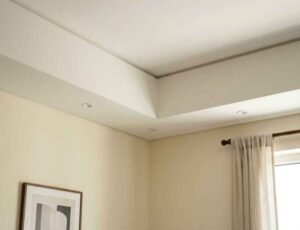
Two things are working against you that don’t exist in most other cities:
- The AC ducting. Most Dubai apartments run cooling ducts along the ceiling perimeter, boxed in with a gypsum bulkhead. That bulkhead can eat 15–20cm of ceiling height around the edges of a room, and if it’s not finished in the same colour as the ceiling, your eye reads it as a separate, lower layer — which makes the whole room feel shorter than it is.
- Heat and dust change what materials you can use. Fabrics and finishes that aren’t UV-stable fade fast against direct sun through floor-to-ceiling glass, and standard grout can pick up dust discolouration within a year on a balcony-facing wall. This isn’t a decoration issue — it’s a materials-selection issue, and it’s the reason a “Pinterest-perfect” light-coloured sofa fabric that works fine in a cooler climate can look tired here within 18 months.
On top of that, most small apartments in Dubai were finished to a fairly plain developer spec — small-format beige tile, chrome fixtures, a single central ceiling light per room — which was fine in 2008 but reads as dated now, and doesn’t do you any favours on space either. Small-format tile in particular works against you: more grout lines mean more visual breaks, and your eye reads each break as the edge of the room.
None of this means the apartment can’t feel bigger. It means the fix usually isn’t “buy more storage” — it’s addressing the two or three things above that are actually working against the space.
What You Can Actually Change: Cosmetic vs. Structural
This is the part almost nobody writing about small apartment renovation in Dubai actually explains properly, and it’s the part that will save you the most money and hassle if you get it right at the start. (For the full breakdown, see our complete guide to renovation permits and NOCs in Dubai.)
Cosmetic work — repainting, replacing flooring, swapping light fixtures, new wardrobe doors, re-tiling a bathroom without moving plumbing — usually only needs sign-off from your building management or developer, and in most towers this is a fast, low-friction approval.
Structural work — removing a wall, moving a kitchen, changing plumbing or electrical routing — is a different process entirely:
- The wall has to be confirmed as non-structural before anyone touches it. This isn’t optional and it isn’t something a general contractor should be guessing at — get it confirmed properly.
- Depending on the building, you may need Dubai Municipality or Trakhees approval, and that process typically takes 2–6 weeks before work can start.
- Any changes to electrical or AC routing usually need separate DEWA approval, which typically adds another 1–3 weeks.
- If you’re a tenant, you need written landlord consent and separate building management clearance — and a lot of standard Dubai tenancy contracts prohibit structural alterations outright, even with landlord sign-off. Read your lease before you fall in love with an open-plan layout.
- Skipping this step isn’t a small risk. Unapproved structural work can mean a stop-work order, fines, and being made to restore the space at your own cost.
Practically, this means: if you’re a tenant with 12 months left on a lease, plan your renovation around cosmetic and semi-structural changes (glass partitions instead of full wall removal, sliding doors instead of widened doorways) rather than banking on a wall coming down. If you’re an owner and structural change is genuinely worth it, build the 2–6 week permit window into your timeline from day one — the renovation companies that quote you a start date without mentioning this step are the ones who cause the delays you read about in Dubai renovation horror stories.
Space-Saving Ideas That Actually Hold Up
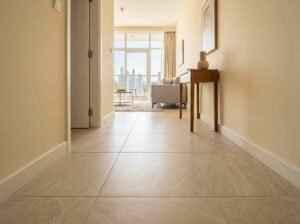
Every small-apartment article recommends “use mirrors” and “go light and neutral.” Fine advice, badly explained. Here’s the mechanism behind the ones actually worth doing, and why they work.
Flooring: consistency beats material choice
Running the same flooring from your entrance through the living area and into the bedroom, without a threshold break, is the single change that does the most to a small apartment’s sense of scale. Every time the flooring changes, your eye registers it as the end of one room — even if the rooms are open to each other. Large-format tile (600x600mm rather than 300x300mm) compounds the effect, because fewer grout lines mean less visual fragmentation. A light stone-effect porcelain in the 600×600 range is a practical, durable choice for Dubai’s dust and humidity, and it’s not a premium-only material — it’s available at a wide range of price points.
Mirrors only work when they reflect something

A mirror on a blank internal wall does almost nothing. A mirror placed opposite a window, or opposite whatever your best sightline is, reflects the light and the depth beyond it — that’s what actually doubles the visual size of a room. Placement matters more than size.
Storage: built-in beats freestanding every time
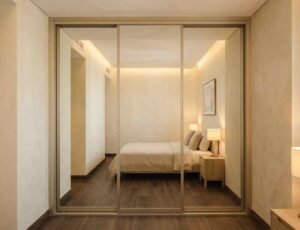
A freestanding wardrobe sits proud of the wall and eats floor space on both sides. A built-in wardrobe taken to full ceiling height uses a dead zone you’re already not using, and closes the gap that usually collects dust above a standard 2.1m unit. If storage is your main frustration, this is usually the highest-value single change in a small apartment, ahead of paint or lighting. (See our storage and joinery service page for built-in options by room.)
Lighting: layer it, don’t centre it
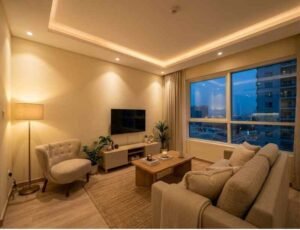
A single central ceiling fitting is the default in almost every Dubai apartment, and it’s the flattest, least flattering way to light a room. Splitting light into three layers — ambient (ceiling), task (under-cabinet, desk), and accent (a floor lamp or cove strip) — does more for how a small space feels in the evening than almost anything else on this list, and it’s one of the cheaper changes to make.
Balconies aren’t dead space
A lot of small-apartment balconies in Dubai end up as storage for whatever doesn’t fit inside. Two foldable chairs, a weatherproof rug, and a set of solar-powered fairy lights can turn a narrow balcony into somewhere you’d actually sit for AED 500–1,000 — no permit required, and it’s usable eight or nine months of the year here.
What This Looks Like in Practice: A Typical Before and After
To make this concrete, here’s the pattern we see most often on a dated 1-bedroom in the 550–700 sq ft range — not a single client case study, but the composite of dozens of similar jobs:
| Element | Before | After |
|---|---|---|
| Flooring | Mixed — beige ceramic in living areas, worn carpet in bedroom | Consistent 600x600mm porcelain throughout, no threshold breaks |
| Kitchen | Dated laminate cabinets, cramped counter space | Repainted or replaced cabinet fronts, under-cabinet task lighting |
| Storage | Single freestanding wardrobe, visible gap above | Full-height built-in wardrobe, mirrored sliding doors |
| Lighting | One central ceiling fitting per room | Layered ambient, task, and accent lighting with dimmers |
| Bathroom | Small-format tile, framed shower screen, standard mirror | Large-format tile, frameless screen, illuminated mirror |
The typical spend for this exact scope sits in the AED 80,000–110,000 range and takes 8–10 weeks. It’s not the most dramatic transformation possible — that requires structural change and a bigger budget — but it’s the one that moves the needle most per dirham spent, and it’s achievable without touching a single wall. (For more transformation patterns by room and budget tier, see our full before-and-after gallery.)
Does It Change by Apartment Type? Yes.
A studio’s biggest problem is usually zoning — sleeping, working, and living areas bleeding into each other with no visual separation. A sliding partition or a well-placed storage unit that also acts as a room divider solves this without losing square footage to a wall. (Full breakdown: studio apartment renovation Dubai.)
A one-bedroom’s biggest problem is usually the second function nobody planned for — a home office, mostly. Wall-mounted, fold-away desks integrated into existing joinery solve this without sacrificing a full room. (Full breakdown: 1-bedroom apartment renovation Dubai.)
A two-bedroom used as a 2BR + occasional guest room has different math entirely — you’re often better off converting the underused second room into a proper home office with a fold-out guest option than keeping it half-furnished as a guest room that sits empty 340 nights a year. (Full breakdown: 2-bedroom apartment renovation Dubai.)
What This Actually Costs
Real numbers, not “contact us for a quote.” (Full cost methodology and ROI data: renovation cost Dubai.)
| Scope | Cost range | Typical timeline |
|---|---|---|
| Cosmetic refresh (paint, flooring, lighting, fixtures) | AED 45,000–80,000 | 3–5 weeks |
| Mid-range renovation (new kitchen cabinetry, full flooring, wardrobes) | AED 80,000–125,000 | 8–12 weeks |
| Full structural renovation (wall removal, layout change, full fit-out) | AED 125,000–200,000+ | 12–20 weeks, including permit time |
If you’re renovating to rent the apartment out rather than live in it, spend where tenants actually notice: kitchen and bathroom upgrades consistently deliver the strongest rental uplift, while high-end imported materials in a mid-tier building rarely pay for themselves — your achievable rent is set by the building and area, not by how expensive your marble is. A renovated small apartment in a well-located building typically lets in 2–4 weeks versus 6–12 weeks for a dated unit in the same tower, and that faster turnover is often worth more over a year than the cosmetic upgrade itself.
How to Avoid Getting Burned (This Is the Part Everyone’s Actually Worried About)
Search Dubai renovation forums for more than five minutes and you’ll hit the same complaint over and over: quotes that change once the work has already started, and no clear record of what was agreed. Here’s how to protect yourself, plainly. (Full guide: how to vet a renovation contractor in Dubai.)
- Get an itemized quote, by room and by material — not a single lump-sum number. If a quote can’t be broken down, you can’t compare it against anyone else’s, and you won’t be able to tell what changed later.
- Ask for daily site photos as standard, not as a favour. Any contractor doing honest work has no reason to object to this.
- Decide upfront who’s sourcing materials. Some homeowners buy tile, sanitaryware, and hardware themselves and have the contractor install only — it takes more of your time but removes a common source of markup disputes. Others prefer the contractor to handle everything for a single point of accountability. Either is fine; just decide before work starts, not after.
- Be specific about finishes, not just categories. “Microcement flooring” isn’t a single spec — quality and application method vary hugely, and it’s a finish that’s easy to under-deliver on if the exact product and process aren’t named in the contract. The same caution applies to any finish where the name alone doesn’t tell you what you’re getting.
- Ask for two or three past clients you can actually call. A contractor with a real track record in Dubai has no reason to hesitate on this.
None of this is complicated. It’s just the difference between a renovation that goes the way it was quoted and one that doesn’t.
Timing: When to Do This, and When Not To
Construction work in Dubai residential buildings generally has to happen within set hours — typically 7:00 AM to 8:00 PM on weekdays, with shorter allowed hours on Saturdays and most work restricted on Fridays and public holidays. If your contractor is proposing anything outside that window, ask why.
November through March is the practical high season for renovation work here — the heat isn’t fighting your contractors, and AC dependency during the build is lower. January and February are also when it’s worth having a contractor check balcony drainage and any exterior waterproofing, since that’s when Dubai’s occasional winter rain tends to expose weak points that don’t show up the rest of the year.
A Quick Note on Where You Live
Renovation priorities genuinely differ by area, and not just cosmetically. A lot of the small-apartment stock in Dubai Marina and JBR — the towers along Marina Walk and a short walk from JBR Beach — dates from roughly 2005–2012, and it’s now old enough that a full renovation makes real financial sense rather than just a refresh. Newer buildings around Business Bay, within view of the Burj Khalifa across the water, and parts of Downtown Dubai near the Dubai Mall and Museum of the Future often only need a lighter, post-handover-style update rather than a full strip-out. If you’re in JVC, Discovery Gardens, or International City, material and labour costs tend to run noticeably lower than Marina or Downtown for the same scope of work, simply because of access logistics and community-specific requirements in the premium towers closer to Sheikh Zayed Road’s most built-up stretch. (See our full list of areas we serve.)
Ready to Actually Do This?
If you’ve read this far, you already know more about how a small Dubai apartment renovation actually works than most of what’s published on the topic. The next step is getting a real, itemized assessment for your specific apartment — not a generic quote based on square footage alone.
Book a free, no-obligation site visit and we’ll walk your apartment with you, tell you honestly what’s cosmetic and what would need approval, and give you a real itemized number — not a range pulled from a brochure.
📞 [Your phone number] · ✉️ [Your email] · 📍 [Your office address/service area]
Frequently Asked Questions
How much does it cost to renovate a small apartment in Dubai?
A cosmetic refresh typically costs AED 45,000–80,000, and a full mid-range renovation with new cabinetry and flooring runs AED 80,000–125,000. Cost depends most on whether the work is cosmetic (paint, flooring, fixtures) or involves structural changes like wall removal, which adds both cost and permit time.
Can tenants renovate apartments in Dubai?
Only with written landlord consent and separate building management clearance, and many standard tenancy contracts prohibit structural changes outright even with landlord approval. Cosmetic changes are generally more achievable for tenants than structural ones — check your lease before planning anything permanent.
Do I need a permit to remove a wall in my apartment?
Yes, if the wall is load-bearing or shared with adjoining units, and even for non-structural walls you typically need building management or developer sign-off first. Dubai Municipality or Trakhees approval for structural changes generally takes 2–6 weeks, and skipping this step risks fines and forced restoration.
What is a realistic renovation budget for a Dubai apartment?
For a small apartment, budget AED 45,000 at the low end for cosmetic work and up to AED 150,000–200,000 for a full structural renovation. The realistic figure depends on unit size, whether walls are moving, and finish level — get an itemized quote rather than relying on a per-square-foot rule of thumb.
What are the construction noise hours in Dubai?
Residential construction work is generally permitted 7:00 AM to 8:00 PM on weekdays, with reduced hours on Saturdays and most work restricted on Fridays and public holidays. Confirm your specific building’s rules with management, since some communities set stricter limits.
How do I avoid hidden charges during a renovation?
Get an itemized quote broken down by room and material, ask for daily site photos as standard practice, agree upfront on who’s sourcing materials, and get specific product names for any finish rather than a category name alone. Ask for two or three past clients you can call directly.
What’s the best time of year to renovate an apartment in Dubai?
November through March is the practical high season, since lower outdoor temperatures make site work easier and reduce AC strain during the build. January and February are also a good time to have balcony drainage and waterproofing checked, since that’s when winter rain tends to expose weak points.
How long does a small apartment renovation take in Dubai?
A cosmetic refresh typically takes 3–5 weeks. A mid-range renovation with new cabinetry and flooring runs 8–12 weeks. A full renovation involving structural changes runs 12–20 weeks, including permit and approval time — not construction time alone.